The Guest-Ready Room Is Not a Standard
A guest-ready room can still support daily life. Use a simple hosting plan to make visitors feel welcome without keeping the space permanently staged.
The most common spare-room mistake is treating a guest bed as the room’s only legitimate purpose. That can leave you with a space nobody uses comfortably—and make hosting feel like a scramble when a visitor does arrive. A guest-ready room works better when it is arranged around the small rituals of being a guest: arriving with a bag, changing clothes, finding a light switch, and settling in without asking where everything is.
What makes a guest room feel considerate?
Consideration is less about hotel-like styling than about reducing little uncertainties. A visitor should be able to tell where to sleep, where to put a bag, and how to find a towel or switch on a lamp.
Look at the room from the doorway as if you had just arrived. Is the bed easy to recognize? Is there a clear place to set down belongings? Can someone reach the lamp without searching behind furniture? These details make the room feel prepared even if a sewing basket or desk remains in view.
A bedside lamp, a wastebasket, clean bedding, and a chair with an empty seat are often enough to establish the basics. If your home has an unfamiliar thermostat or curtains, a brief note can spare a guest the awkwardness of asking.
How can the room support your own routines between visits?
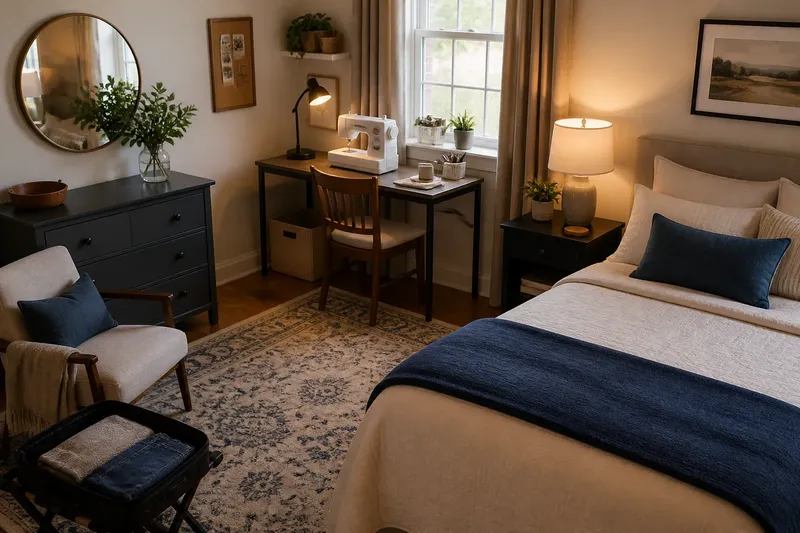
Give the spare room a daily role that does not compromise the guest’s comfort. A desk for paperwork, a reading chair, or a sewing station can coexist with a bed if the sleeping area and a place for belongings remain easy to reclaim.
Think in terms of guest rituals rather than a general demand for open floor. A visitor may need to open a suitcase, reach a drawer, or change clothes in privacy. Those needs can guide what you leave clear more precisely than the idea that the whole room must stay empty.
Say you use a compact spare room for mending clothes. Imagine the starting setup is a bed, a sewing machine on a narrow desk, and fabric in two bins. You move the fabric into one lidded bin beneath the desk, keep the machine on its surface, and reserve the chair and a dresser drawer for a visitor. When a guest arrives, the visible result is a usable bed, a place for a bag, and a drawer that opens without moving your supplies; the tradeoff is that the sewing setup stays in the room rather than disappearing entirely.
What belongs in the guest’s arrival zone?
Think of the arrival zone as a small landing strip: not an empty room, just a few places where a visitor can put things down without first moving yours. A clear chair, a dresser corner, and an accessible outlet can do more than decorative accessories.
Choose what to keep available according to the kind of visit your household usually hosts. A short visit may need a surface for a small bag and a hook for a coat. A longer stay may call for an empty drawer or shelf. If a visitor has particular needs, ask directly rather than guessing.
- Check whether the bed is accessible; if the route is blocked, move the obstacle or choose a different furniture arrangement.
- Check whether a chair has a clear seat; if it is piled with laundry, put the laundry in its usual hamper or provide another empty spot.
- Check whether a visitor can place a bag on a stable surface; if not, clear a dresser corner or move a side table within reach.
- Check whether a drawer or shelf is empty; if it is occupied, clear one small area or tell the visitor where belongings can go.
- Check whether the bedside lamp works from the bed; if it does not, replace the bulb or move the lamp to an accessible outlet.
- Check whether charging cords cross a walking path; if they do, reroute them along the wall or leave the outlet free for the guest’s charger.
- Check whether clean sheets and towels are easy to identify; if they are mixed with household linens, place the guest set together in a labeled bag or drawer.
How do you reset the room without a full makeover?
Use a short sequence tied to what a guest will actually do. Clear the sleeping surface, make the bedding available, empty one place for belongings, and remove anything private that should not be handled. Then stand at the doorway and check whether the essentials are obvious.
Keep supplies together so the reset does not become a search. A labeled linen bag can hold sheets and towels; a small basket can collect desk items that need to move temporarily. A predictable home for these things is like a drawer organizer: it keeps the useful pieces from becoming a mixed-up pile.
If the room doubles as an office, also consider whether papers or screens reveal personal information. Put sensitive documents away and decide whether a guest should have access to the room during work hours. The room can be welcoming without pretending that your household has no private life.
Can the room work as an office and a guest room?
Yes, if the desk does not prevent a visitor from using the bed, settling belongings, or getting dressed. A compact desk and a bed can share a room, but the office chair should not be the only place to put a suitcase.
Match the arrangement to the work. A laptop and notebook may fit on a simple surface, while paperwork may need a drawer or cabinet that can close. Keep cords away from walking routes, and avoid placing office equipment where a guest must shift it to reach the bed.
If work calls and visits overlap, address the schedule as well as the furniture. A screen may offer visual privacy, but it will not make a call quiet or give a visitor uninterrupted access. Agree on when the room is needed and identify another place for either activity if they conflict.
What do people ask about a guest-ready room?
Does a spare room have to stay empty?
No. It can support work, hobbies, or reading between visits as long as you can prepare a comfortable sleeping area and a place for the guest’s belongings. The room’s everyday use does not make it less hospitable.
Should the bed stay made all the time?
Not necessarily. If you use the bed for reading or folding laundry, let it serve that purpose and prepare it when a visit is planned. Keeping clean bedding together makes the changeover easier.
What if there is no room for a guest bed?
A daybed, sofa bed, or foldaway sleeping option may suit the space, depending on the room and the visitor. If none offers a comfortable arrangement, discuss another sleeping plan before the visit rather than squeezing furniture into a route that needs to stay clear.
How much storage should I leave for a visitor?
Leave a place suited to the stay, such as a clear drawer, shelf, or surface for a bag. If visits vary, keep one area easy to empty instead of reserving a whole dresser by default.
When should you choose another room arrangement?
A different arrangement may make more sense if the spare room’s current setup makes hosting uncomfortable or keeps the household from using an important space. You might use a daybed instead of a full bed, or keep the room as an office and plan another sleeping option when needed.
Be clear about what the room can offer: a private place to sleep, a shared bathroom, limited storage, or a quiet spot only at certain times. That honesty lets visitors plan without asking the room to do something it cannot comfortably do. For accessibility or other specific needs, ask the person staying what would help and make a suitable plan together.
For guest-ready room ideas, start with the visitor’s arrival: where they will put a bag, find a light, and locate clean bedding. Once those moments are covered, the rest of the room can remain part of your home’s daily life. A useful guest room does not need to wait silently for company; it simply needs a thoughtful way to make room when someone comes.