Before the Showroom: How the Reading Lamp Found Its Place
Trace how the reading lamp became a seat-side object, and see how its changing form reflects the private habits and shared spaces of home reading.
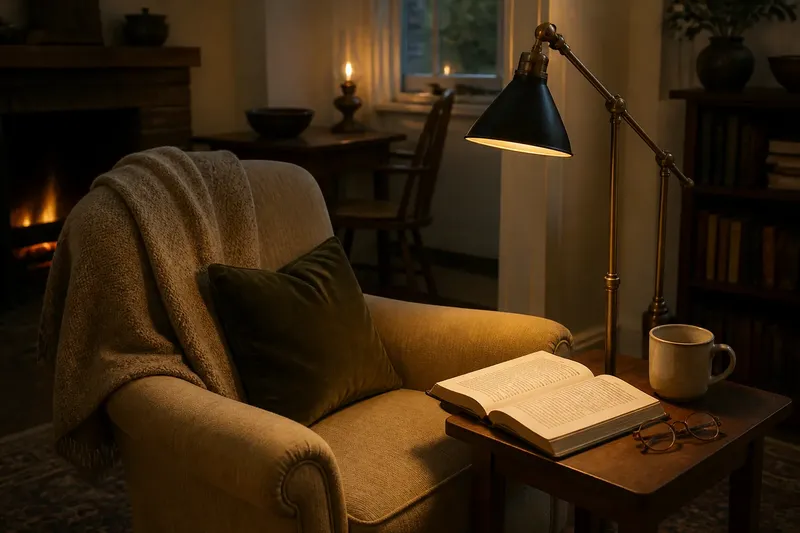
The common mistake is to treat a reading lamp as a finishing touch after choosing the chair; the cost is missing the way this object grew from everyday reading habits. The reading lamp’s history is less a straight march toward brighter rooms than a story about bringing useful light closer to one reader.
Why did readers seek light near their seats?
In many homes, a hearth, candle, oil lamp, or central fixture served several people and purposes at once. Reading could share that light with conversation, meals, mending, or other work. The details varied by household, place, and period, so it is better to think of shared illumination as a common arrangement than a universal rule.
A reader who wanted to continue after others had turned to another activity had to adapt to the room’s light. Some read close to a shared source; others could use a separate lamp when one was available. What matters for the reading lamp’s story is the domestic problem it answered: how to see a page without asking the entire room to gather around one point of light.
As lighting options changed, the household could arrange light around particular activities as well as around the room. That did not replace shared light. It made room for a smaller zone of attention: a chair, a book, and a source directed toward the page.
How did the lamp become part of a reading corner?
The reading lamp became recognizable through use before it became a neat category in a shop. A reader might bring a lamp near a chair, adjust its shade, or set it on a table already used for a book and a cup. These ordinary arrangements linked the object to a recurring place in the home.
Different forms answered different furniture habits. A table lamp belonged beside a chair when a side table was already part of the room. A floor lamp could stand beside a seat without claiming that surface. A movable arm offered another way to direct light, while a shade could help keep the brightest part of the lamp out of someone’s direct view.
These forms did not emerge in a single tidy sequence, and no one design defines the history of the reading lamp. Their shared purpose is more revealing: they let a household place light where reading happened, rather than requiring a reader to fit a routine around a central fixture.
What did a reading lamp change in the room?
A lamp beside a chair made lighting more local. The page could be easier to see while the rest of the room remained softer, and another person could continue a different activity nearby. The reading corner was not necessarily a separate room; it was a small arrangement that gave one habit a place.
The arrangement also made the lamp part of the furniture’s rhythm. Someone needed to reach its switch, leave space for its base, and direct its shade toward a book rather than another person’s eyes. A lamp that fit those movements could feel at home even when it did not match the rest of the room.
Think of the lamp like a bookmark: its value depends not just on being near the book, but on being in the right place when you reach for it. That simple relationship between object, seat, and habit helps explain why the reading lamp remained more than a smaller version of general room lighting.
Why did reading lamps take different forms?
A table lamp made sense where a reader already had a side table. It could share that surface with reading glasses or a book, though a crowded tabletop left little room for its base and shade.
A floor lamp answered a different need: light near a chair without relying on a table. Wall-mounted lamps kept the floor and tabletop clear but fixed the source to one location. Portable or clip-on lamps offered flexibility for readers who moved between seats, though their narrower beam or controls might not suit every routine.
These are not simply product choices; each form suggests a different relationship between a reader and a room. The table lamp belongs to a settled surface, the floor lamp to a patch of open floor, and the wall lamp to a habitual seat. Their variety reflects the many ways a household makes space for reading.
What do people still ask about reading lamps?
Why is a reading lamp placed beside a chair?
A lamp beside a chair can direct light toward a page without lighting the whole room as brightly. Its position also makes the switch and shade part of the reader’s ordinary reach.
How did reading lamps differ from general room lighting?
General lighting serves a broader area, while a reading lamp is arranged around a particular seat or task. That distinction let one person read without making the entire room revolve around the same light.
Why did some reading lamps have adjustable arms?
An adjustable arm let the user bring light closer to a book or change its direction. It suited a reading habit that shifted with the position of the chair, page, or reader.
Did the reading lamp replace shared household lighting?
No; it added a more local source alongside the room’s general or shared light. A reading corner could coexist with the rest of the household’s activities.
What can the reading lamp’s history tell us now?
Imagine a household with one chair near a side table and a reader who often picks up a book after someone else has settled in the room. The household places a shaded lamp on the table, turns it toward the page, and leaves the broader room light available. The visible result is a reading spot that feels distinct without becoming a separate room; if the side table is already needed for other things, a floor lamp would express the same habit with a different footprint.
The reading lamp’s story is not only about illumination; it is also about where a household allows a quiet routine to happen. That history still helps explain the object’s place at home: look for the seat, surface, and reach that make reading part of the room rather than an interruption to it.